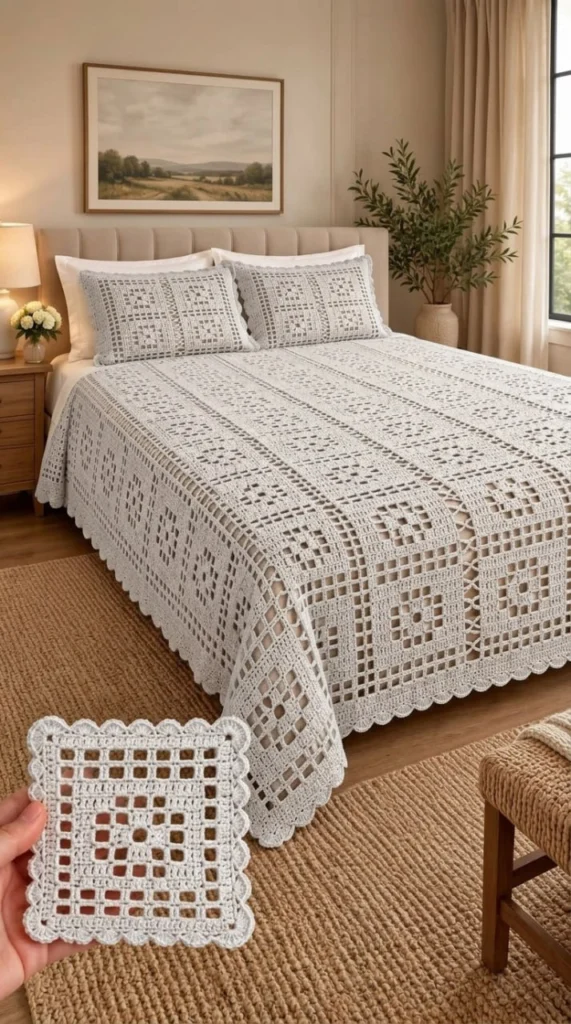
Classic Grey Filet Lace Bedspread — Free Crochet Pattern
Intermediate
For crocheters comfortable with the basics, ready to try new shaping and assembly techniques
Weekend Project
A satisfying weekend make — start Friday, finish Sunday, enjoy forever.
Handmade Gift
A beautiful keepsake — free forever. Read online or print at home.
About This Classic Grey Filet Lace Bedspread — Free Crochet Pattern
The Classic Grey Filet Lace Bedspread free crochet pattern brings a timeless vintage heirloom look to your bedroom space[cite: 7, 10]. Crafted in an elegant light grey cotton yarn tone, this bedspread features structured square motifs worked in classic filet lace gridwork, featuring a central square window motif surrounded by radiating open mesh, framed in crisp double crochet bands and delicate scalloped picot edges[cite: 7, 10]. Complete with matching decorative pillow shams, this pattern blends old-world craftsmanship with crisp, modern bed styling[cite: 7, 10].
This project is constructed by crocheting individual square filet lace motifs that are joined together into vertical strips separated by delicate joining lattice strips, then framed with a continuous scalloped outer border[cite: 7, 10]. It is ideal for an intermediate crocheter comfortable with filet mesh (blocks and open spaces), even gauge management, square framing, and precise motif assembly[cite: 7, 10].
Materials
- Yarn: 100% Cotton or Cotton-Acrylic blend in DK weight (Weight 3) or Worsted weight (Weight 4) in Light Grey / Silver-Grey[cite: 7, 10].
- Main Color (Light Grey): ~3,600 meters (~3,930 yards) for the full queen bedspread and two pillow shams[cite: 7, 10].
- Crochet Hook: 4.0 mm (US G/6) crochet hook, or size required to match gauge and drape[cite: 7, 10].
- Notions: Tapestry needle for weaving in ends and seaming, locking stitch markers, sharp yarn scissors, measuring tape[cite: 7, 10].
- Blocking Tools: Blocking boards or foam mats, stainless steel rust-proof T-pins, and steam iron or spray bottle[cite: 7, 10].
Abbreviations
chchain[cite: 7, 10]sl stslip stitch[cite: 7, 10]scsingle crochet[cite: 7, 10]hdchalf double crochet[cite: 7, 10]dcdouble crochet[cite: 7, 10]trtreble crochet[cite: 7, 10]incincrease[cite: 7, 10]st(s)stitch(es)[cite: 7, 10]sp(s)space(s)[cite: 7, 10]ch-spchain space[cite: 7, 10]open mesh (mesh)dc in st, ch 1, skip 1 st, dc in next st[cite: 7, 10]solid block (block)2 dc worked in space or 1 dc in each st[cite: 7, 10]picotch 3, sl st into 3rd ch from hook[cite: 7, 10]Instructions
Main Filet Square Motif — Light Grey (make ~80 motifs for Queen size)
Each motif is worked in concentric rounds starting from a small center ring, forming a geometric filet lattice window pattern bounded by a solid double crochet frame and scalloped outer picots[cite: 7, 10].
Part 1: Central Filet Grid Core
- Round 1: With Light Grey yarn, make a magic ring[cite: 7, 10]. Ch 3 (counts as dc), work 3 dc into ring, ch 2, *4 dc into ring, ch 2; repeat from * 2 more times[cite: 7, 10]. Join with sl st to top of starting ch-3[cite: 7, 10]. [16 dc, 4 ch-2 corner sps]
- Round 2: Ch 3, dc in next 3 sts, *[2 dc, ch 2, 2 dc] in corner ch-sp, dc in next 4 sts; repeat from * 2 more times, [2 dc, ch 2, 2 dc] in last corner sp[cite: 7, 10]. Join with sl st[cite: 7, 10]. [32 dc]
- Round 3 (First Open Mesh Ring): Ch 4 (counts as dc + ch 1), skip next st, dc in next st, ch 1, skip next st, *[2 dc, ch 2, 2 dc] in corner sp, (ch 1, skip 1 st, dc in next st) across side; repeat from * around[cite: 7, 10]. Join with sl st[cite: 7, 10]. [8 open mesh sps, 16 corner dc]
- Round 4: Ch 3, dc in each ch-1 sp and dc across each side, working [2 dc, ch 2, 2 dc] in each ch-2 corner sp[cite: 7, 10]. Join with sl st[cite: 7, 10]. [64 dc]
- Round 5 (Outer Mesh Layer): Ch 4 (counts as dc + ch 1), *skip 1 st, dc in next st, ch 1; repeat from * to corner, work [2 dc, ch 2, 2 dc] in corner sp; repeat around all 4 sides[cite: 7, 10]. Join with sl st[cite: 7, 10]. [24 open mesh sps total]
- Round 6: Ch 3, work 1 dc in each st and 1 dc in each ch-1 sp across all sides, working [2 dc, ch 2, 2 dc] in each corner sp[cite: 7, 10]. Join with sl st[cite: 7, 10]. [96 dc]
Part 2: Outer Framing Band & Scalloped Picot Edge
- Round 7 (Frame Window Row): Ch 4, *skip 1 st, dc in next st, ch 1; repeat to corner, [2 dc, ch 2, 2 dc] in corner sp; repeat around[cite: 7, 10]. Join with sl st[cite: 7, 10]. [40 open mesh sps]
- Round 8 (Solid Outer Border): Ch 3, dc in each st and ch-1 sp around, working [2 dc, ch 2, 2 dc] in each corner sp[cite: 7, 10]. Join with sl st[cite: 7, 10]. [128 dc]
- Round 9 (Scalloped Edging): *Skip 2 sts, work [3 dc, picot, 3 dc] in next st, skip 2 sts, 1 sc in next st; repeat from * along each side, placing [4 dc, picot, 4 dc] into each ch-2 corner sp[cite: 7, 10]. Join with sl st[cite: 7, 10]. Fasten off and weave in ends[cite: 7, 10]. [Square motif size = ~22 x 22 cm]
Joining Lattice Strips
To connect the vertical rows of squares, narrow Filet Joining Strips are worked continuously between columns[cite: 7, 10].
- Row 1: Attach Light Grey yarn to top corner of first vertical column of squares[cite: 7, 10]. Ch 5 (counts as tr + ch 1)[cite: 7, 10]. *Dc in next st, ch 1, skip 1 st; repeat along the side of the motif column to the end[cite: 7, 10]. Turn[cite: 7, 10].
- Row 2: Ch 4 (counts as dc + ch 1), dc in next dc, *ch 1, dc in next dc; repeat across[cite: 7, 10]. Turn[cite: 7, 10].
- Row 3: Join to adjacent column using flat sl st joining method through the picot loops of the neighboring motifs[cite: 7, 10]. Fasten off[cite: 7, 10].
Bedspread Assembly
- Arrangement: Lay out all 80 square motifs in an 8 x 10 grid (8 columns wide by 10 rows long) on a flat surface[cite: 7, 10].
- Seaming: Using Light Grey yarn and a tapestry needle, whipstitch adjacent motif picot loops and outer border edges together through the back loops only (BLO) to keep all seam lines flat and neat[cite: 7, 10].
- Attach Joining Strips: Insert the Filet Joining Strips between each vertical column to match the structural openwork pattern seen in the bedspread[cite: 7, 10].
Continuous Outer Scalloped Bedspread Border
- Round 1 (Base Anchor Row): Attach Light Grey yarn in any corner of the assembled blanket[cite: 7, 10]. Ch 1, work single crochets evenly along all 4 outer edges, placing 3 sc in each outer corner[cite: 7, 10]. Join with sl st[cite: 7, 10].
- Round 2 (Filet Window Outer Band): Ch 4 (counts as dc + ch 1), *skip 1 st, dc in next st, ch 1; repeat around entire outer perimeter, working [2 dc, ch 2, 2 dc] in outer corners[cite: 7, 10]. Join with sl st[cite: 7, 10].
- Round 3 (Scalloped Shell Border): *Skip 2 sts, work [3 dc, picot, 3 dc] in next st, skip 2 sts, 1 sc in next st; repeat from * continuously around all 4 outer sides of the bedspread[cite: 7, 10]. Join with sl st, fasten off, and weave in all loose ends[cite: 7, 10].
Matching Pillow Shams (make 2)
Front Sham Panel
- Join 6 main Filet Square Motifs in a 3×2 grid[cite: 7, 10].
- Work Round 8 and Round 9 of the outer frame around the perimeter to square off the panel to ~45 x 65 cm[cite: 7, 10].
Back Sham Panel
- Row 1: Ch 82[cite: 7, 10]. Dc in 4th ch from hook and in each ch across[cite: 7, 10]. Turn[cite: 7, 10]. [80 dc]
- Rows 2–35: Ch 3 (counts as dc), 1 dc in each st across[cite: 7, 10]. Turn[cite: 7, 10]. Fasten off after Row 35 [80 dc per row; panel ~45 x 65 cm][cite: 7, 10].
Assembly of Shams
Place front and back panels wrong sides together[cite: 7, 10]. Single crochet around 3 sides using Light Grey yarn, insert a pillow form (~45 x 65 cm), then sc across the 4th side[cite: 7, 10]. Finish with the scalloped picot border around the outer edge[cite: 7, 10].
Tips for Success
- Maintain Strict Tension: Filet crochet relies on precise gauge to ensure open mesh windows remain crisp and perfectly square across all 80 motifs[cite: 7, 10].
- Block Individual Motifs: Steam blocking each square motif to ~22 x 22 cm before seaming makes alignment significantly easier and prevents puckering along the joining strips[cite: 7, 10].
- Use Mercerized Cotton: Mercerized cotton yarn gives high stitch definition to openwork grids and resists pilling over long-term use[cite: 7, 10].
- Count Mesh Windows Every Round: Missing a skipped stitch in openwork rounds will shift the geometric alignment of outer solid frames[cite: 7, 10].
- Relax Seaming Stitches: Keep assembly stitches supple so the blanket lies flat without stiff seams on the bed[cite: 7, 10].
Common Mistakes to Avoid
- Skipping Motif Blocking — Unblocked filet squares curl at the corners, making row-by-row seaming uneven[cite: 7, 10].
- Miscounting Skipped Stitches — Skipping 2 stitches instead of 1 in open mesh rounds distorts the square dimensions into a rectangle[cite: 7, 10].
- Using Too Soft/Fuzzy Yarn — Fuzzy yarns obscure the clean openwork window pattern of filet lace; stick to smooth cotton threads or yarns[cite: 7, 10].
- Uneven Joining Tension — Pulling assembly threads too tightly creates puckered ridges along the joining lattice strips[cite: 7, 10].
Ways to Customize This Pattern
- Pastel & Earth Tone Shades: Try working this pattern in soft sage green, pale duck-egg blue, or warm linen beige for a rustic look[cite: 7, 10].
- Throw Blanket Dimension: Reduce motif count to 35 squares (5 x 7 grid) to create a smaller sofa throw (~110 x 150 cm)[cite: 7, 10].
- Matching Table Runner: Join a single column of 5 squares end-to-end to craft a matching filet lace dining table runner[cite: 7, 10].
Frequently asked questions
This pattern is rated as intermediate[cite: 7, 10]. It requires familiarity with filet crochet mesh principles, counting double crochet blocks, working concentric square expansions, and seaming geometric motifs together[cite: 7, 10].
How long does it take to complete this queen-size bedspread?
A full queen bedspread with matching shams typically takes between 4 and 6 weeks of regular crocheting (~12–15 hours per week)[cite: 7, 10].
A DK or Worsted weight 100% cotton or cotton-acrylic blend is best[cite: 7, 10]. Cotton provides crisp stitch definition for open mesh spaces and washes exceptionally well[cite: 7, 10].
Machine wash on a gentle, cool cycle inside a large laundry bag using mild liquid detergent[cite: 7, 10]. Lay flat on clean dry towels to air dry to preserve its geometric lace structure[cite: 7, 10].
Yes! Because this is a modular motif pattern, simply add or subtract rows of squares[cite: 7, 10]. Each square motif adds approximately 22 cm (~8.5 inches) to the length or width[cite: 7, 10].
Can I sell finished items made from this pattern?
Yes, you are welcome to sell physical finished items created using this pattern[cite: 7, 10]. We kindly ask that you credit patterns.noobcooks.com as the original designer in your listings[cite: 7, 10]. Reselling, copying, or redistributing the written pattern text or images is strictly prohibited[cite: 7, 10].
The finished Classic Grey Filet Lace Bedspread — Free Crochet Pattern