Sunburst Hexagon Bedspread — Free Crochet Pattern
Intermediate
For crocheters comfortable with the basics, ready to try new shaping and assembly techniques
Weekend Project
A satisfying weekend make — start Friday, finish Sunday, enjoy forever.
Handmade Gift
A beautiful keepsake — free forever. Read online or print at home.
About This Sunburst Hexagon Bedspread — Free Crochet Pattern
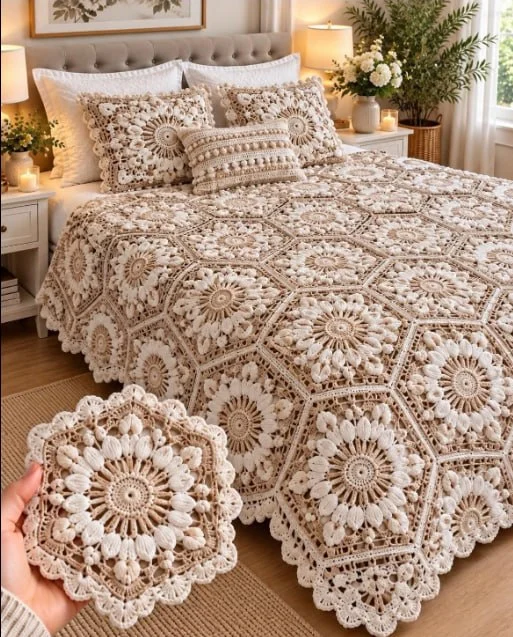
This sunburst hexagon bedspread free crochet pattern recreates the romantic, vintage-look blanket in the photo: dozens of lace hexagon motifs, each one blooming with a raised cream petal ring around a fine taupe sunburst centre, tiled together into a honeycomb that drapes softly over a queen-size bed. What makes this piece special is the combination of textures inside every single motif — a delicate spoke wheel centre, plump puffy petals, an airy openwork ring behind them, and a neat hexagon body finished with tiny pointed picots — so the blanket reads as floral lace from across the room and rewards a close look with layer after layer of detail. The two-tone palette of warm cream and soft mushroom taupe keeps it calm and heirloom-like, easy to pair with almost any bedroom. Despite its intricate appearance, every motif is built from the same eight rounds repeated roughly a hundred times, which makes the work wonderfully portable and rhythmic once you find your flow.
The bedspread is constructed entirely from identical hexagon motifs worked in rounds from the centre out, then blocked and joined in an offset honeycomb layout. The skill level is intermediate: the stitches are straightforward (double crochet, single crochet, chains and one puff stitch), but the openwork rounds demand accurate counting, and the final look depends on blocking every motif to the same size before joining. If you have made a granny square and feel ready for something lacier, this is the perfect next project — one motif is a lovely evening’s work, and each finished hexagon is deeply satisfying to hold.
Materials
- Cream DK cotton or cotton-acrylic, approx 1.7 kg (about 17 x 100 g balls, roughly 4,200 m) — used for the petals, spoke round, and the two outer rounds of each motif
- Soft taupe (mushroom beige) DK cotton or cotton-acrylic, approx 0.9 kg (about 9 x 100 g balls, roughly 2,200 m) — used for the sunburst centre and the middle openwork round
- 5.0 mm (US H/8) crochet hook
- Tapestry needle for joining and weaving ends
- Scissors
- Blocking mats and plenty of rust-proof T-pins — with lace motifs this size, blocking is not optional
- Stitch markers for marking the first motif of each row while laying out
Abbreviations
chchainscsingle crochetdcdouble crochetsl stslip stitchskskipsp(s)space(s)st(s)stitch(es)reprepeatMRmagic ringpuff[yo, insert hook, yo, pull up a loop] 5 times in same st or sp (11 loops on hook), yo, pull through all loops, ch 1 to closeInstructions
Before you begin: Work one complete motif and block it. It should measure roughly 25 cm across the flats (side to side). If it is smaller, move up to a 5.5 mm hook; if it is larger, drop to a 4.5 mm hook. The blanket is laid out in offset honeycomb rows of pointy-top hexagons — approximately 10 motifs across and 10 to 11 rows deep, about 100 motifs in total for a queen-size bedspread with a generous drape. Your exact motif count will follow your gauge and your preferred overhang, so confirm the plan with your test motif before buying yarn.
Sunburst hexagon motif — two-tone (make approx 100)
- Round 1 (taupe — centre ring): Make a MR. Ch 3 (counts as dc here and throughout), 17 dc in ring, sl st into top of beg ch-3, pull the ring tight. (18 dc)
- Round 2 (cream — spoke round): Ch 1 (does not count as a st), sc in same st, *ch 3, sc in next st; rep from * 17 more times, sl st into first sc. You should have 18 spoke spaces radiating from the centre like a wheel. (18 sc, 18 ch-3 sps)
- Round 3 (cream — petal round): Sl st into first ch-3 sp, ch 2 (does not count as a st), puff in same sp, ch 1; *puff in next ch-3 sp, ch 1; rep from * 16 more times, sl st into the closing ch of first puff. Push each puff gently toward the front as you go — the petals should stand up. (18 puffs, 18 ch-1 sps)
- Round 4 (taupe — openwork ring): Ch 1, sc in top of first puff, *ch 3, sc in top of next puff; rep from * 16 more times, ch 3, sl st into first sc. The ch-3 spaces behind the petals create the lacy shadow ring you see between the flowers. (18 sc, 18 ch-3 sps)
- Round 5 (cream — hexagon, first corners): Sl st into first ch-3 sp, ch 3, 2 dc in same sp, ch 2, 3 dc in same sp (first corner made), 3 dc in each of next 2 sps; *(3 dc, ch 2, 3 dc) in next sp, 3 dc in each of next 2 sps; rep from * 4 more times, sl st into top of beg ch-3. (24 groups of 3 dc, 72 dc, 6 corner ch-2 sps)
- Round 6 (taupe): Sl st into next 2 dc and into first ch-2 sp, ch 3, 2 dc in same sp, ch 2, 3 dc in same sp (corner), *3 dc in each of next 3 sps, (3 dc, ch 2, 3 dc) in next corner sp; rep from * 4 more times, 3 dc in each of the last 3 sps, sl st into top of beg ch-3. (30 groups, 90 dc, 6 corner sps)
- Round 7 (cream): Work as Round 6, working 3 dc in each of the 4 sps along every side between corners. (36 groups, 108 dc, 6 corner sps)
- Round 8 (cream — picot point edge): Sl st into next 2 dc and into first side sp, ch 1, sc in same sp, *ch 3, sl st into first ch (picot made), sc in next sp; rep from * along the side, working at each corner point (sc, picot, sc, picot, sc) so the corner stands up to a soft point, then continue along the next side; work all 6 sides, sl st into first sc. Fasten off, leaving a 20 cm tail for joining. (approx 54 sc, approx 54 picots)
Block every motif to 25 cm across the flats, pinning the six points out gently. The lace rounds relax enormously with blocking — an unblocked motif is typically 3 to 4 cm too small and looks nothing like the photo.
Joining the motifs
- Lay the blocked motifs on a large flat surface in an offset honeycomb: rows of motifs with each row shifted half a motif to the side, pointy-top orientation, all facing the same way. Aim for about 10 motifs per row and 10 to 11 rows; adjust to your bed and your gauge.
- Whip stitch the motifs together with the cream yarn tail through the back loops of the edge stitches, seam by seam. Lace-to-lace seams should sit nearly invisible; keep the tension relaxed so the honeycomb keeps its drape.
- Alternatively, join as you go: on the final motif of your pile, work Round 8 as normal but slip-stitch into the matching picot edge of the neighbouring motif every few stitches. This halves the finishing time — but practise the rhythm on a pair of spare motifs first.
- When the blanket is fully joined, weave in every tail on the wrong side, running each through at least 5-6 stitches in different directions before trimming.
Finishing
- Evening border round (cream): Join cream yarn at any outer point. Work a round of sc evenly around the entire blanket, working 2 sc into the valleys and (sc, ch 3 picot, sc) into each outer point, so the scalloped honeycomb edge becomes a continuous lace trim.
- Final wet-block: Wet-block the finished bedspread flat on towels or mats, opening every point and valley. Cotton lace takes one to two days to dry fully. Once dry, the seams disappear and the sunburst flowers pop in relief, exactly as in the photo.
Tips for Success
- Count the spoke round out loud. 18 spokes, 18 puffs, 18 taupe spaces — if any round lands on the wrong multiple, the mistake is almost always a missed or extra space in Round 2. Everything else in the motif depends on it.
- Close puffs consistently. Always close with the same ch 1 and snug it gently. Loose closing chains make petals floppy; tight ones make the ring pucker.
- Block motifs in batches, not all at the end. Pinning and drying 100 motifs in one weekend is misery; pinning ten while the next ten dry is painless.
- Weave the centre tail in immediately after Round 1 — in a magic ring worked with 18 stitches it tends to loosen later if left hanging.
- Keep your corner ch-2 spaces uniform. They are the skeleton of the hexagon; if they creep tighter as the rounds grow, the motif will cup instead of lying flat.
- Buy the cream in a single dye lot. At 17-plus balls, a lot mismatch will show as subtle striping across the blanket. Taupe matters less since it sits in the centres.
- Safety-pin your layout rows. A locking marker on the first motif of each row stops the honeycomb from drifting half a motif out of alignment as you seam.
Common Mistakes to Avoid
- Skipping the test motif — it happens when the maker trusts the hook size on the ball band. Lace gauges vary wildly between hands; a 1 cm difference per motif becomes 10 cm across the bed. Make one, block it, measure it.
- Working the spoke round with uneven tension — if some ch-3 spokes are tight and others loose, the petals tilt and the flower looks lopsided. Aim for spokes you could fit a pencil through.
- Forgetting the ch 1 after each puff — without it the petals fuse into a solid ring and Round 4 has nowhere to anchor. The count is 18 puffs and 18 ch-1 spaces, always.
- Joining unblocked motifs — they differ by several centimetres and the seams will pucker no matter how carefully you sew. Block first, always.
- Over-tight seams — pulled-tight whip stitches turn the honeycomb into a stiff net. The seam should feel like a row of crochet, not a drawstring.
- Losing track of the hexagon corners from Round 5 onward — each side must gain exactly one space per round (2, then 3, then 4). Miscount here is why a motif gains seven corners or turns into a circle.
Ways to Customize This Sunburst Hexagon Crochet Pattern
- Size it down: a 5 x 6 motif layout (30 hexagons) makes a beautiful sofa or pram throw of roughly 120 x 140 cm, and a single row of motifs becomes a stunning table runner.
- Swap the palette: white with silver-grey centres reads winter bridal; sage and cream reads cottage; dusty rose and ivory reads nursery; charcoal and linen reads strikingly modern. Keep the centre colour slightly darker than the petals for the sunburst effect to show.
- Go brighter: make the petals in a soft ombre — three shades of one colour, one shade per third of the motifs — for a gradient blanket that fades across the bed.
- Worsted weight version: with a 5.5 mm hook and aran cotton, each motif finishes around 30-32 cm; a 7 x 8 layout covers a queen bed with only 56 motifs, at the cost of a heavier blanket.
- Frame the flowers: work Round 6 in the contrast taupe and Round 7 in cream (as written), or reverse them so the outer body reads taupe and the picots cream — both look lovely; the photo shows the cream-dominant version.
Frequently asked questions
For a queen-size bedspread with a drape like the photo, plan on roughly 100 motifs at the written gauge (25 cm each) — about 10 across and 10 to 11 rows in the offset honeycomb. The honest way to know is to join your first six motifs and measure the little patch; honeycomb maths is far kinder when measured than when calculated. For a throw, 25 to 30 motifs are plenty.
Most intermediate makers spend about 45 to 60 minutes per motif once in a rhythm, plus blocking and joining, bringing the total to roughly 80 to 100 hours spread over 6 to 8 weeks. Crocheting two or three motifs an evening and seaming once a week makes steady, pleasant progress without burnout.
Can a beginner make this?
A confident beginner who has already made granny squares can, yes. The only truly new technique is the puff stitch, and it appears in exactly one round. The openwork rounds teach you to read spaces instead of stitches, which is a genuinely valuable skill. Make two or three practice motifs before counting any of them toward the blanket.
Cupping means the corner ch-2 spaces or the final rounds are too tight — go up a hook size or consciously loosen the chains. Ruffling means too many stitches, usually from working extra groups into the side spaces from Round 5 onward; recount that each side gains exactly one space per round. And if the fabric looks right but slightly wavy, it simply needs blocking — wet cotton lace transforms.
Yes — on Round 8, slip-stitch into the matching edge of the neighbouring motif every few stitches instead of working free picots. It is faster and the seam is flatter, but the rhythm takes a couple of practice motifs to learn, and you must plan the layout before you start. Traditional whip stitching afterwards gives you more freedom to rearrange.
Cotton or cotton-acrylic versions machine wash cold on a gentle cycle; dry flat or tumble dry low. Because of the three-dimensional petals, reshape the flowers with your fingers while damp and let it dry flat so the sunburst centres keep their shape. A quick steam with an iron held above the fabric refreshes the lace between washes.
Can I sell finished items made from this pattern?
Yes — finished items may be sold, with credit given to the pattern source. The written pattern itself may not be resold, republished or redistributed, in full or in part, in any form.
The finished Sunburst Hexagon Bedspread — Free Crochet Pattern