Frosted Pineapple Doily Runner — Free Crochet Pattern
Intermediate
For crocheters comfortable with the basics, ready to try new shaping and assembly techniques
Single-Day Project
A satisfying project you can complete in a single afternoon or evening.
Handmade Gift
A beautiful keepsake — free forever. Read online or print at home.
About This Frosted Pineapple Doily Runner — Free Crochet Pattern
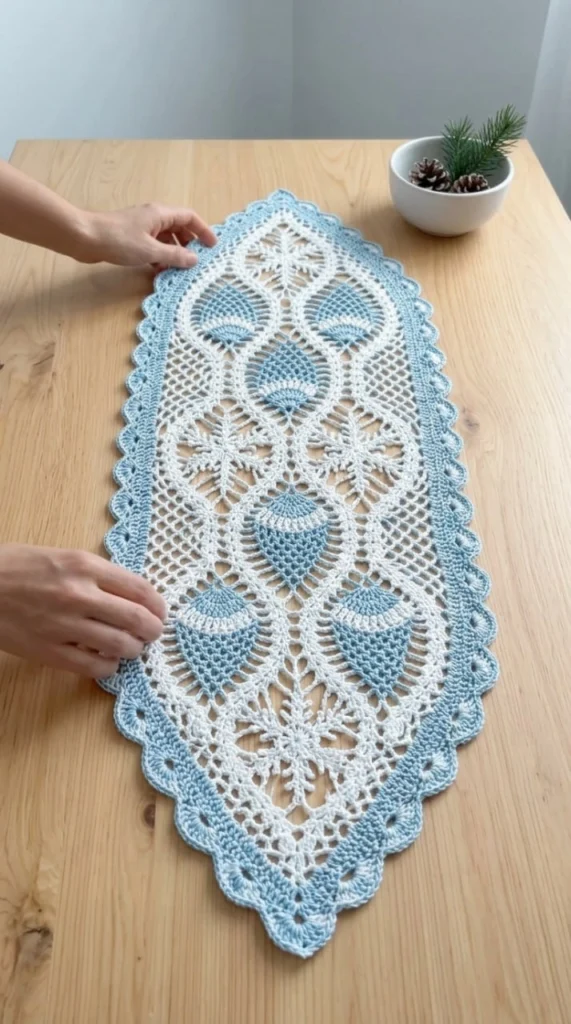
This frosted pineapple doily runner free crochet pattern recreates the elegant table piece in the photo: a long oval runner built from delicate white pineapple lace, dotted with soft powder-blue pineapples that read like little frosted ornaments against the snowy openwork. What makes this piece special is the classic pineapple motif — plump fan-shaped scales stacked into tapering ovals — worked in two tones so the blue pineapples glow against the white lattice, all framed by a scalloped blue shell border that ripples gently around the edge. The runner is worked in one piece from the centre outward in joined rounds, so there is no seaming at all: you start with a small oval, grow it with pineapple repeats, and finish with the pretty blue edging. It looks like an heirloom but works up in a couple of evenings, and it lies perfectly flat thanks to the pineapple geometry that practically blocks itself.
The construction is a classic oval doily method: a starting chain forms the ring, rounds build the flat oval base, and the pineapple pattern repeats in panels around the oval, with the colour changes worked by carrying the unused shade up the wrong side. The skill level is intermediate — the stitches are simple (double crochet, chains, shells and clusters), but the openwork demands accurate counting and the colour changes need a little confidence. If you can crochet a flat doily and are comfortable changing colours mid-round, you can absolutely make this runner.
Materials
- White fingering cotton or cotton-acrylic, approx 150 g (about 600 m) — used for the base, the white pineapple panels, and the inner edging
- Powder blue fingering cotton or cotton-acrylic, approx 100 g (about 400 m) — used for the blue pineapples and the scalloped border
- 4.0 mm (US G/6) crochet hook
- Tapestry needle for weaving ends
- Scissors
- Blocking mats and rust-proof T-pins — blocking is what turns the lace from curly to crisp
- Stitch markers for marking the first stitch of each round
Abbreviations
chchainscsingle crochetdcdouble crochettrtreble crochetsl stslip stitchskskipsp(s)space(s)st(s)stitch(es)reprepeatshell5 dc in same st or spcluster3 dc closed together (work 3 dc leaving last loop of each on hook, yo, pull through all 4 loops)Instructions
Before you begin: Work the first 8 rounds and block the piece. It should measure about 15 cm wide and 20 cm long at this point. If it is smaller, go up to a 4.5 mm hook; if it is larger, drop to a 3.5 mm hook. The runner finishes at roughly 30 x 90 cm — a generous table runner or dresser scarf. The colour changes are worked by dropping the old colour and picking up the new one at the start of a round; carry the unused colour loosely up the wrong side, catching it every few stitches so it does not dangle.
Runner — white base (make 1)
- Round 1: With white, ch 26. Join with sl st to first ch to form a ring. Ch 3 (counts as dc here and throughout), 2 dc in same ch, 1 dc in each of next 24 ch, 5 dc in last ch (first end made), working along the other side of the chain: 1 dc in each of next 24 ch, 3 dc in last ch, sl st into top of beg ch-3. (56 dc)
- Round 2: Ch 3, dc in same st, 2 dc in next st, 1 dc in each of next 24 dc, 2 dc in each of next 5 dc, 1 dc in each of next 24 dc, 2 dc in each of next 3 dc, sl st into top of beg ch-3. (68 dc)
- Round 3: Ch 3, dc in same st, 1 dc in next st, 2 dc in next st, 1 dc in each of next 24 dc, (2 dc in next st, 1 dc in next st) 5 times, 1 dc in each of next 24 dc, (2 dc in next st, 1 dc in next st) 3 times, sl st into top of beg ch-3. (76 dc)
- Round 4: Ch 3, dc in same st, 1 dc in each of next 2 sts, 2 dc in next st, 1 dc in each of next 24 dc, (2 dc in next st, 1 dc in each of next 2 sts) 5 times, 1 dc in each of next 24 dc, (2 dc in next st, 1 dc in each of next 2 sts) 3 times, sl st into top of beg ch-3. (84 dc)
- Round 5: Ch 3, dc in same st, 1 dc in each of next 3 sts, 2 dc in next st, 1 dc in each of next 24 dc, (2 dc in next st, 1 dc in each of next 3 sts) 5 times, 1 dc in each of next 24 dc, (2 dc in next st, 1 dc in each of next 3 sts) 3 times, sl st into top of beg ch-3. (92 dc)
- Round 6: Ch 3, dc in same st, 1 dc in each of next 4 sts, 2 dc in next st, 1 dc in each of next 24 dc, (2 dc in next st, 1 dc in each of next 4 sts) 5 times, 1 dc in each of next 24 dc, (2 dc in next st, 1 dc in each of next 4 sts) 3 times, sl st into top of beg ch-3. (100 dc)
- Round 7: Ch 3, dc in same st, 1 dc in each of next 5 sts, 2 dc in next st, 1 dc in each of next 24 dc, (2 dc in next st, 1 dc in each of next 5 sts) 5 times, 1 dc in each of next 24 dc, (2 dc in next st, 1 dc in each of next 5 sts) 3 times, sl st into top of beg ch-3. (108 dc)
- Round 8: Ch 3, dc in same st, 1 dc in each of next 6 sts, 2 dc in next st, 1 dc in each of next 24 dc, (2 dc in next st, 1 dc in each of next 6 sts) 5 times, 1 dc in each of next 24 dc, (2 dc in next st, 1 dc in each of next 6 sts) 3 times, sl st into top of beg ch-3. (116 dc)
Pineapple panels — alternating colours (make 1)
- Round 9: Ch 4 (counts as dc, ch 1), sk 1, dc in next st, ch 1, sk 1, dc in next st; rep from * around, working (dc, ch 3, dc) at each end point, sl st into 3rd ch of beg ch-4. (58 dc, 58 ch-1 sps)
- Round 10: Sl st into first ch-1 sp, ch 3, 2 dc in same sp, ch 1, 3 dc in next ch-1 sp, ch 1; rep from * around, working (3 dc, ch 3, 3 dc) at each end point, sl st into top of beg ch-3. (174 dc, 58 ch-1 sps)
- Round 11: Sl st into next 2 dc and into first ch-1 sp, ch 3, 2 dc in same sp, ch 2, 3 dc in next ch-1 sp, ch 2; rep from * around, working (3 dc, ch 3, 3 dc) at each end point, sl st into top of beg ch-3. (174 dc, 58 ch-2 sps)
- Round 12: Sl st into next 2 dc and into first ch-2 sp, ch 3, 2 dc in same sp, ch 3, 3 dc in next ch-2 sp, ch 3; rep from * around, working (3 dc, ch 3, 3 dc) at each end point, sl st into top of beg ch-3. (174 dc, 58 ch-3 sps)
- Round 13: Sl st into next 2 dc and into first ch-3 sp, ch 3, 2 dc in same sp, ch 4, 3 dc in next ch-3 sp, ch 4; rep from * around, working (3 dc, ch 4, 3 dc) at each end point, sl st into top of beg ch-3. (174 dc, 58 ch-4 sps)
- Round 14: Sl st into next 2 dc and into first ch-4 sp, ch 3, 2 dc in same sp, ch 5, 3 dc in next ch-4 sp, ch 5; rep from * around, working (3 dc, ch 5, 3 dc) at each end point, sl st into top of beg ch-3. (174 dc, 58 ch-5 sps)
- Round 15: Sl st into next 2 dc and into first ch-5 sp, ch 3, 2 dc in same sp, ch 6, 3 dc in next ch-5 sp, ch 6; rep from * around, working (3 dc, ch 6, 3 dc) at each end point, sl st into top of beg ch-3. (174 dc, 58 ch-6 sps)
- Round 16: Sl st into next 2 dc and into first ch-6 sp, ch 3, 2 dc in same sp, ch 7, 3 dc in next ch-6 sp, ch 7; rep from * around, working (3 dc, ch 7, 3 dc) at each end point, sl st into top of beg ch-3. (174 dc, 58 ch-7 sps)
Blue pineapples — colourwork (make 1)
- Round 17: Join blue at any side ch-7 sp. Ch 3, 2 dc in same sp, ch 7, 3 dc in next ch-7 sp, ch 7; rep from * around, working (3 dc, ch 7, 3 dc) at each end point, sl st into top of beg ch-3. (174 dc, 58 ch-7 sps)
- Round 18: Sl st into next 2 dc and into first ch-7 sp, ch 3, 2 dc in same sp, ch 6, 3 dc in next ch-7 sp, ch 6; rep from * around, working (3 dc, ch 6, 3 dc) at each end point, sl st into top of beg ch-3. (174 dc, 58 ch-6 sps)
- Round 19: Sl st into next 2 dc and into first ch-6 sp, ch 3, 2 dc in same sp, ch 5, 3 dc in next ch-6 sp, ch 5; rep from * around, working (3 dc, ch 5, 3 dc) at each end point, sl st into top of beg ch-3. (174 dc, 58 ch-5 sps)
- Round 20: Sl st into next 2 dc and into first ch-5 sp, ch 3, 2 dc in same sp, ch 4, 3 dc in next ch-5 sp, ch 4; rep from * around, working (3 dc, ch 4, 3 dc) at each end point, sl st into top of beg ch-3. (174 dc, 58 ch-4 sps)
- Round 21: Sl st into next 2 dc and into first ch-4 sp, ch 3, 2 dc in same sp, ch 3, 3 dc in next ch-4 sp, ch 3; rep from * around, working (3 dc, ch 3, 3 dc) at each end point, sl st into top of beg ch-3. (174 dc, 58 ch-3 sps)
- Round 22: Sl st into next 2 dc and into first ch-3 sp, ch 3, 2 dc in same sp, ch 2, 3 dc in next ch-3 sp, ch 2; rep from * around, working (3 dc, ch 3, 3 dc) at each end point, sl st into top of beg ch-3. (174 dc, 58 ch-2 sps)
- Round 23: Sl st into next 2 dc and into first ch-2 sp, ch 3, 2 dc in same sp, ch 1, 3 dc in next ch-2 sp, ch 1; rep from * around, working (3 dc, ch 3, 3 dc) at each end point, sl st into top of beg ch-3. (174 dc, 58 ch-1 sps)
Finishing
- Border round 1 (blue): Join blue at any side ch-1 sp. Ch 1, sc in same sp, *ch 3, sc in next ch-1 sp; rep from * around, working (sc, ch 3, sc) at each end point, sl st into first sc. (58 sc, 58 ch-3 sps)
- Border round 2 (blue): Sl st into first ch-3 sp, ch 1, (sc, ch 3, sc) in same sp, *5 dc in next ch-3 sp, (sc, ch 3, sc) in next ch-3 sp; rep from * around, working 7 dc at each end point, sl st into first sc. (29 shells, 58 sc)
- Border round 3 (blue): Sl st into first 3 dc of shell, ch 1, sc in same dc, *ch 5, sc in 3rd dc of next shell; rep from * around, working (sc, ch 7, sc) at each end point, sl st into first sc. (29 ch-5 sps, 2 ch-7 sps)
- Border round 4 (blue): Sl st into first ch-5 sp, ch 1, (sc, ch 3, sc) in same sp, *5 dc in next ch-5 sp, (sc, ch 3, sc) in next ch-5 sp; rep from * around, working 7 dc in each ch-7 sp, sl st into first sc. (31 shells, 62 sc)
- Final round (blue): Sl st into first 3 dc of shell, ch 1, sc in same dc, *ch 3, sc in 3rd dc of next shell; rep from * around, working (sc, ch 5, sc) at each end point, sl st into first sc. Fasten off. (31 ch-3 sps, 2 ch-5 sps)
- Weave in all ends on the wrong side, running each tail through at least 5-6 stitches in different directions before trimming.
- Blocking: Wet-block the finished runner on blocking mats, pinning every point of the blue scallops and opening the pineapple lace fully. Cotton lace takes 12-24 hours to dry. Once dry, the runner lies perfectly flat and the pineapples stand out in crisp relief.
Tips for Success
- Count the chain spaces, not the stitches. From Round 9 onward, every round is built from ch-1, ch-2, ch-3… ch-7 spaces. If your count is off, a space got skipped — the mistake is always in the previous round’s spaces.
- Keep the chain spaces loose. Tight chains make the pineapples pucker and the runner cup. If your chains are hard to work into, go up a hook size or consciously relax your tension.
- Carry the unused colour up the wrong side. Catch it every 3-4 stitches with a loose float so it does not dangle or pucker the fabric. The floats disappear completely after blocking.
- Mark the first stitch of every round. With 58 spaces per round, it is easy to lose your place. A locking marker in the first stitch saves endless recounting.
- Block aggressively. Cotton lace shrinks and curls when worked. Pin every point, every pineapple scale, and every shell. The runner will grow 10-15% with blocking — that is normal and intended.
- Weave ends in as you change colours. With two colours and 23 rounds, a giant end-weaving session at the end is miserable. Weave each tail in immediately after fastening off.
Common Mistakes to Avoid
- Skipping the gauge check — it happens when makers assume all fingering cotton and a 4 mm hook behave the same. A 1 cm difference per round becomes 5-6 cm across the width of the runner; work the first 8 rounds and measure before continuing.
- Inconsistent chain space sizes — alternating accidentally between ch 4 and ch 5 makes some pineapples tall and others squat. Every space in a round is the same size, no exceptions.
- Working into the wrong space — the 3-dc groups go into the spaces between chains, not into the chains themselves. Working into the chain makes a tight, dense fabric instead of open lace.
- Pulling the colour floats too tight — it draws the fabric in and makes the runner pucker. Floats should be loose enough to lie flat when the fabric relaxes.
- Forgetting the end point increases — each end point needs (dc, ch X, dc) or (3 dc, ch X, 3 dc) to keep the oval flat. Missing one makes the end point curl up like a bowl.
- Blocking half-heartedly — pinning only the outer edge and not the pineapple scales leaves the interior lumpy. Pin every scale open; the extra ten minutes transform the piece.
Ways to Customize This Frosted Pineapple Doily Runner Crochet Pattern
- Size it up or down: for a longer runner, add one more pineapple repeat (Rounds 9-16) before the blue section; for a smaller doily, stop after Round 16 and work the border in white only.
- Swap the palette: white with sage green pineapples reads spring; white with blush pink reads Valentine; ecru with chocolate brown reads autumn; white with silver grey reads winter frost.
- Go monochrome: work the entire runner in white or cream for a traditional heirloom look, or in a single soft colour like pale blue or lavender for a tinted lace effect.
- Make it a set: work the same pattern but stop after Round 12 for a 15 cm doily, or after Round 8 for a 10 cm coaster — a matching table set in three sizes.
- Add beads: string small seed beads onto the blue yarn before starting and slide one into the tip of each pineapple scale for a subtle sparkle that catches candlelight.
Frequently asked questions
Most intermediate makers report 10 to 14 hours of actual hook time: roughly 4 hours for the white base and pineapple panels, 3 hours for the blue pineapples and border, and 3 to 7 hours for blocking and finishing depending on how obsessively you pin. It is an ideal weekend project — start Friday evening, block Sunday, use it Monday.
Can I use a heavier yarn?
Yes, with a 5.0 or 5.5 mm hook and DK cotton, the runner finishes around 40 x 120 cm — a generous table runner or dresser scarf. The pineapples will be bolder and the fabric denser. Always make the first 8 rounds and measure before committing to the full project.
Almost always one of two things: the chain spaces are too tight (the fabric cups), or the end point increases are missing (the oval turns into a bowl). Loosen your chains, confirm the (dc, ch X, dc) at each end, and block aggressively. Wet cotton lace transforms with blocking — do not judge the shape until it is pinned and dry.
Can a beginner make this?
A confident beginner who has made a flat doily or two can, yes. The only truly new techniques are the pineapple shaping (which is just chain spaces growing and shrinking) and the colour changes. Make the first 8 rounds twice as practice before counting any of them toward the runner.
Cotton or cotton-acrylic versions machine wash cold on a gentle cycle; dry flat. Because of the openwork, reshape the pineapples with your fingers while damp and pin lightly if needed. A quick steam with an iron held above the fabric refreshes the lace between washes. Store it flat or rolled, never folded sharply, to keep the pineapples crisp.
Absolutely — work the entire runner in white, cream, or any single colour you love. The pineapple texture is the star, and it shows beautifully in monochrome. The two-tone version simply highlights the pineapple shapes, but the lace is lovely either way.
Yes — finished items may be sold, with credit given to the pattern source. The written pattern itself may not be resold, republished or redistributed, in full or in part, in any form.
The finished Frosted Pineapple Doily Runner — Free Crochet Pattern