Autumn Harvest Mandala Runner — Free Crochet Pattern
Intermediate
For crocheters comfortable with the basics, ready to try new shaping and assembly techniques
Multi-Day Project
A rewarding 12+ hour journey — perfect for dedicated crafters who love detailed work.
Handmade Gift
A beautiful keepsake — free forever. Read online or print at home.
About This Autumn Harvest Mandala Runner — Free Crochet Pattern
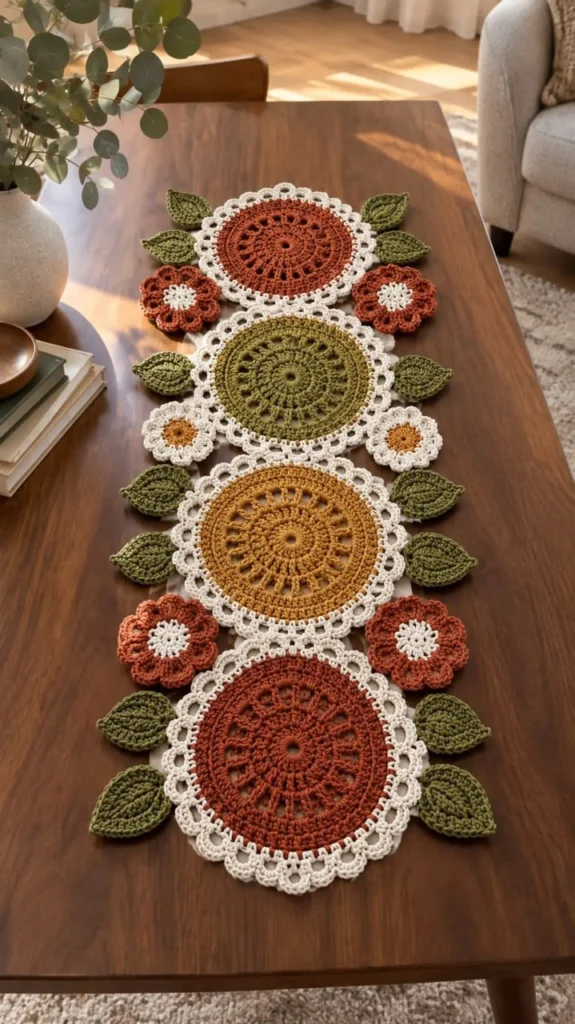
This autumn harvest mandala runner free crochet pattern recreates the warm, seasonal table piece in the photo: a winding runner built from circular mandala medallions in rich terracotta, olive green, and golden mustard, each framed by a delicate white lace edging and linked by smaller flowers and leaves in coordinating shades. What makes this piece special is the combination of dense, textured mandala centres with airy white openwork frames, creating a stained-glass effect that catches the light beautifully. The serpentine layout — where each medallion overlaps the next like stepping stones — gives the runner its flowing, organic movement, while the scattered flowers and leaves add a whimsical, botanical touch that celebrates the colours of fall. Despite its intricate appearance, the runner is built from just four repeatable elements: mandala medallions, small flowers, leaves, and the joining chain, making it a satisfying project that works up over a few cozy evenings.
The construction is modular: you work circular mandala motifs in three autumn colours, frame each with a white lace edging, then join them in an offset serpentine chain with smaller flowers and leaves tucked between. The skill level is intermediate: the stitches are straightforward (double crochet, single crochet, chains and clusters), but the colour changes and the lace edging require attention to tension, and the final look depends on blocking every element to open the lace fully. If you have made mandalas, doilies, or granny squares and are ready for a project that combines colourwork with dimensional appliqué, this runner will bring autumn warmth to your table for years to come.
Materials
- Terracotta DK cotton or cotton-acrylic, approx 100 g (about 1 x 100 g ball, roughly 240 m) — used for two mandala medallions and small flowers
- Olive green DK cotton or cotton-acrylic, approx 100 g — used for one mandala medallion, leaves, and small flower centres
- Golden mustard DK cotton or cotton-acrylic, approx 100 g — used for one mandala medallion and small flower centres
- Soft white DK cotton or cotton-acrylic, approx 150 g — used for the lace edgings, joining, and flower petals
- 4.0 mm (US G/6) crochet hook
- Tapestry needle for seaming and weaving ends
- Scissors
- Blocking mats and rust-proof T-pins — blocking is essential for the lace to lie flat
- Stitch markers for holding elements together while seaming
Abbreviations
chchainscsingle crochethdchalf double crochetdcdouble crochettrtreble crochetsl stslip stitchskskipsp(s)space(s)st(s)stitch(es)reprepeatMRmagic ringcluster3 dc closed together (work 3 dc leaving last loop of each on hook, yo, pull through all 4 loops)picotch 3, sl st into first chshell5 dc in same st or spInstructions
Before you begin: Work one mandala medallion and block it. It should measure roughly 20 cm across. If it is smaller, go up to a 4.5 mm hook; if it is larger, drop to a 3.5 mm hook. The runner uses 4 medallions in a serpentine chain, with 6 small flowers and 8 leaves appliquéd between them. Your exact flower and leaf count can vary — that is the beauty of a botanical design.
Mandala medallion — terracotta, olive, and mustard (make 4, one in each colour plus one extra terracotta)
- Round 1 (centre colour): With the main colour (terracotta, olive, or mustard), make a MR. Ch 3 (counts as dc here and throughout), 15 dc in ring, sl st into top of beg ch-3, pull the ring tight. (16 dc)
- Round 2: Ch 3, dc in same st, 1 dc in each of next 3 sts, *2 dc in next st, 1 dc in each of next 3 sts; rep from * around, sl st into top of beg ch-3. (20 dc)
- Round 3: Ch 3, dc in same st, 1 dc in each of next 4 sts, *2 dc in next st, 1 dc in each of next 4 sts; rep from * around, sl st into top of beg ch-3. (24 dc)
- Round 4: Ch 3, dc in same st, 1 dc in each of next 5 sts, *2 dc in next st, 1 dc in each of next 5 sts; rep from * around, sl st into top of beg ch-3. (28 dc)
- Round 5 (openwork): Ch 4 (counts as dc, ch 1), *sk 1, dc in next st, ch 1; rep from * around, sl st into 3rd ch of beg ch-4. (14 dc, 14 ch-1 sps)
- Round 6 (shell round): Sl st into first ch-1 sp, ch 3, 2 dc in same sp, ch 2, 3 dc in next ch-1 sp, ch 2; rep from * around, sl st into top of beg ch-3. (42 dc, 14 ch-2 sps)
- Round 7 (openwork): Sl st into next 2 dc and into first ch-2 sp, ch 4 (counts as dc, ch 1), *sk 1, dc in next st, ch 1; rep from * around, sl st into 3rd ch of beg ch-4. (21 dc, 21 ch-1 sps)
- Round 8 (shell round): Sl st into first ch-1 sp, ch 3, 2 dc in same sp, ch 2, 3 dc in next ch-1 sp, ch 2; rep from * around, sl st into top of beg ch-3. (63 dc, 21 ch-2 sps)
- Round 9 (white — lace edging): Join white with sl st in any ch-2 sp. Ch 1, sc in same sp, *ch 5, sc in next ch-2 sp, picot, ch 5, sc in same sp; rep from * around, sl st into first sc. Fasten off, leaving a 20 cm tail for joining. (42 sc, 21 picots)
Block each medallion to 20 cm, pinning the lace points open. The openwork relaxes enormously with blocking — an unblocked medallion is typically 3-4 cm too small.
Small flowers — two-tone (make 6)
- Round 1 (centre): With mustard or olive green, make a MR. Ch 1, 6 sc in ring, sl st into first sc, pull ring tight. (6 sc)
- Round 2 (petals): Join white or terracotta with sl st in any sc. Ch 1, *sc in next st, ch 3, 3 dc in 3rd ch from hook (petal made), sc in next st; rep from * around, sl st into first sc. Fasten off, leaving a 15 cm tail for sewing. (6 sc, 6 petals)
Leaves — olive green (make 8)
- Row 1: Ch 10. Sc in 2nd ch from hook, hdc in next ch, dc in each of next 6 ch, 5 dc in last ch (tip made), working along the other side of the chain: dc in each of next 6 ch, hdc in next ch, sc in last ch. (20 sts)
- Row 2 (picot edge): Ch 1, turn, sc in first st, *picot, sc in next st; rep from * across. Fasten off, leaving a 15 cm tail for sewing. (10 sc, 9 picots)
Serpentine joining (make 1)
- Lay the 4 blocked medallions on a large flat surface in a serpentine chain: medallion 1 at the top, medallion 2 overlapping it slightly to the right and down, medallion 3 overlapping medallion 2 to the left and down, and medallion 4 at the bottom. The overlap should be about 4-5 cm — enough to join securely but not so much that the medallions bunch.
- Using the white tails and a tapestry needle, whip stitch the overlapping lace edges together with small, invisible stitches, working through both thicknesses. Join medallion 1 to 2, 2 to 3, and 3 to 4. Keep the tension relaxed so the serpentine flows naturally.
- Alternatively, join as you go: on the final round of each medallion, work the lace edging as normal but slip-stitch into the matching lace edge of the previous medallion where they overlap. This creates a seamless join but requires careful placement.
Finishing
- Appliqué placement: Arrange the 6 small flowers and 8 leaves on the serpentine runner as shown in the photo — one flower at each joint between medallions, and leaves tucked along the curves and at the ends. Pin everything in place before sewing.
- Sewing: Using the tails and a tapestry needle, sew each flower and leaf securely to the runner, working through all layers. Sew around the base of each flower and along the centre vein of each leaf, catching a few stitches of the medallion lace. The appliqués should be firmly attached but not flattened.
- Weave in ends: Run each tail through at least 5-6 stitches in different directions on the wrong side before trimming. With this many elements, take your time — a tidy wrong side makes the difference between handmade and heirloom.
- Blocking: Wet-block the finished runner on blocking mats, pinning the serpentine curves into a gentle S-shape and opening every lace point. Cotton takes 12-24 hours to dry fully. Once dry, the runner holds its shape beautifully and the autumn colours glow against the white lace.
Tips for Success
- Count the mandala increases carefully. The solid centre must grow by 4 stitches per round (16, 20, 24, 28). If your count is off, the medallion will be lopsided — the mistake is always a missed or extra increase.
- Keep the chain spaces loose. Tight chains make the lace pucker and the medallion cup. If your chains are hard to work into, go up a hook size or consciously relax your tension.
- Block every medallion before joining. Unblocked medallions vary by several centimetres and the serpentine will pucker. Five minutes per medallion saves hours of regret later.
- Pin the serpentine before sewing. The S-curve is forgiving, but a pinned layout lets you step back and check the flow from across the room before committing.
- Let the flowers keep their dimension. Do not flatten the petals while sewing — the slight curl is what gives the botanical look.
- Weave ends in as you finish each element. With 4 medallions, 6 flowers, and 8 leaves, a giant end-weaving session at the end is miserable. Weave each tail in immediately.
- Buy all your yarn in single dye lots. With multiple colours, lot mismatches will show as subtle striping. Check the lot numbers before you leave the shop.
Common Mistakes to Avoid
- Skipping the test medallion — it happens when makers assume all DK yarn and a 4 mm hook behave the same. A 1 cm difference per medallion becomes 4 cm across the runner; make one first and measure it.
- Inconsistent chain space sizes — alternating accidentally between ch 4 and ch 5 makes some lace points tall and others squat. Every space in a round is the same size, no exceptions.
- Working into the wrong space — the 3-dc groups go into the spaces between chains, not into the chains themselves. Working into the chain makes a tight, dense fabric instead of open lace.
- Joining unblocked medallions — they differ by several centimetres and the seams will pucker no matter how carefully you sew. Block first, always.
- Over-tight seams — pulled-tight whip stitches turn the lace into a stiff net. The seam should feel like a row of crochet, not a drawstring.
- Overcrowding the appliqués — too many flowers and leaves make the runner look cluttered rather than botanical. Less is more; the negative space between elements is part of the design.
Ways to Customize This Autumn Harvest Mandala Runner Crochet Pattern
- Size it up or down: add two more medallions for a longer runner of ~160 cm, or use only 3 medallions for a shorter ~90 cm version. A single medallion with one flower and two leaves makes a stunning trivet or coaster.
- Swap the palette: cream with soft pink and lavender reads spring; white with silver-grey and ice blue reads winter; sage with terracotta and gold reads summer desert; burgundy with forest green and cream reads Christmas.
- Go monochrome: work the entire runner in cream or white for a traditional heirloom look, letting the texture of the lace carry the design.
- Add beads: string small seed beads onto the white yarn before starting and slide one into the tip of each lace point for a subtle sparkle that catches candlelight.
- Make it a set: work smaller versions (Rounds 1-6 only) as matching placemats, or a single medallion as a doily for a side table.
Frequently asked questions
Most intermediate makers report 12 to 16 hours of actual hook time: roughly 6 hours for the 4 medallions, 2 hours for the flowers and leaves, 2-3 hours for joining and appliqué, and 2-5 hours for blocking and finishing depending on how obsessively you pin. It is an ideal weekend project — start Friday evening, block Sunday, use it Monday.
Yes, with a 5.0 or 5.5 mm hook and worsted cotton, the medallions finish around 25-26 cm and the runner around 45 x 150 cm — a generous table runner or dresser scarf. The lace will be bolder and the fabric denser. Always make one medallion first and measure before committing to the full project.
Why are my medallions cupping or ruffling instead of lying flat?
Cupping means the increases are too tight — go up a hook size or consciously loosen the stitches. Ruffling means too many increases per round; recount that each round gains exactly 4 stitches. And if the fabric looks right but slightly wavy, it simply needs blocking — wet cotton lace transforms.
A confident beginner who has made granny squares or simple doilies can, yes. The only truly new techniques are the mandala shaping (which is just increases spaced evenly) and the lace edging. Make one medallion as practice before counting it toward the runner.
Cotton or cotton-acrylic versions machine wash cold on a gentle cycle; dry flat. Because of the dimensional flowers, reshape the petals with your fingers while damp and pin lightly if needed. A quick steam with an iron held above the fabric refreshes the lace between washes. Store it flat or rolled, never folded sharply, to keep the medallions crisp.
Absolutely — the pattern uses terracotta, olive, and mustard for an autumn look, but any colour combination works. Try soft pink with cream centres for a spring version, or deep red with gold centres for a Christmas version. Keep the petals lighter than the centres for the most dimensional effect.
Can I sell finished items made from this pattern?
Yes — finished items may be sold, with credit given to the pattern source. The written pattern itself may not be resold, republished or redistributed, in full or in part, in any form.
The finished Autumn Harvest Mandala Runner — Free Crochet Pattern